Monday, November 11, 2019

FlipGrid Fundementals

FlipGrid Home Page features a button for Educator Login which uses the Microsoft or Google domain account to allow access to the site.


Grids

Previously posted October 2018

A Grid is your classroom or community of learners. Grids have Topics and Topics have Responses.

Adding a New Grid is relatively easy. First click on the +New Grid button. Then, fill in the form that provide the details for your grid. You can designate the community type and choose from school domain (ex. su.edu), a student ID List or make the grip public. The School domain option requires a user account in that Microsoft or Google domain.

There are features that can be activated or deactivated such as notifications, downloads, followers and captions. I activated notifications so I would know when someone posted and allowed downloads in case someone wanted their own copy of their video. I did not activate Grid Followers which would notify students when new Topics are posted or videos recorded nor did I activate captions which would display auto-generated captions for the video.

I did personalize the Grid with a banner image. The banner can be selected from a Library or uploaded from your computer.

Topics
Topics are the individual prompts within the Grid. Add a Topic in the same way as adding a Grid, click the +NewTopic button and again fill in the topic details. The details that can be controlled within a Topic include Response Time (from 15 to 90 seconds in the free version). A Display Date can be set but it requires a paid version to set and end date so the Topic must be manually set to Inactive. Here is where you also add the text for your Question or prompt, set up Moderation if you want to approve video posts.

You can Change the status of the Topic from Active to Frozen to Inactive. Section 4 of the Topic Details has a setting to allow students to respond to one another, allow Video Titles, show the number of views and allow emojis as a reaction to the video. Consider these options carefully based on your purpose and your audience.

The FlipGrid Topics listing shows each Topic created within the Grid and allows for management and utilization of the Topics.


Responses

Once you share the link or code with students, the student can post a response. The interface for students can include a description of the task in either text or a video or both. Students are given a timed window for response. There is a redo button if you don’t like your first take. There is also an option for uploading a video hidden under the options gear. Once the student has recorded there is also option for adding a caption which can include hashtags for improving search capabilities and also attaching a file to the video.

The student responses are shown below with a unique link and actions for sharing and extending the conversation including the creation of a MixTape of the Responses that stand out or each and every one of the recorded Responses. The instructor can create and edit the mix. 


The Student Response roster in flip grid shows each individual response and the tools that can be used to manage and utilize those responses.

I feel there is a fairly easy point of entry for those new to FlipGrid and some solid features and functionality for those that like to either geek out or create more robust possibilities for Topics, Responses and ongoing interactions among students.

There is also great potential for collecting content to create a culminating multimedia project from the Grid to evidence depth of knowledge and the evolution of ideas among learners. I would strongly recommend the nine minute video tutorial by Richard Byrne to help you get started.

Here is an example of a Grid Topic I used with the EDU585 Fall 2019 class. You must use your SU.EDU account to view the Grid Topic.

Monday, March 11, 2019

Deeper Class Discussions with TQE

I read the blog post from @cultofpedagogy and then followed the source to another blog post by @MarisaEThompson and it took me down a path with my EDU 585 students that I wasn't realy expecting. I found myself on a soapbox about purposefulness and intentionality about building relationships with your students, about the higher goals of process over product and some of the demands of the modern classroom and the inherent accountabilty that often lead us away from the very thing we sought to accomplish. Read more about a similar journey of discovery and deeper class discussions with TQE.

Formative Assessment

The conversation started around the use of formative assessment, particularly about digital tools to conduct formative assessment. I wanted to use a simple tool to gather some thoughts from the class to demonstrate one form of finding out their Thoughts, their Questions and their Epiphanies. I choose to use linoit. The information that the class provided was insightful. It gave me a better understanding of what they knew, the questons they had and the ah-ha moments that had come to them during the week's assignement or in the last 5 minutes before we started the activity. See the digital sticky notes they posted below. Click the link below the image to view more.

linoit sticky notes on formative assessment

Formative Assessment TQE 585

Digital Age Learning

The insights from the digital sticky notes helped to drive a discussion that supported statements or answered questions for others and allowed participants to continue sharing their thoughts, asking questions and arriving at their newly formed epiphanies. I hope that their epiphanies were as meaningful as mine. Digital Age Learners, as described by the ISTE Standards for Students, need to be empowered learners, responsible citizens, constructors of knowledge, innovative designers, computational thinkers, creative communicators, and competent collaborators. The students in today's classrooms are far more savvy, far more discerning, and far more capable than we give them proper credit for being and doing. 

Participatory Culture

Learners are not as much engaged by the end product as they are the process. Digital Age Learners yearn for a participatory culture. John Spencer captures seven reasons to show your work. He talks about when people share their work they begin thinking about your thinking, innovating, mentoring collaborating, storytelling, building courage, embracing revision and shares this revelation to summarize the value sharing your work.

"When students only share their highly polished, finished work, they miss out on the opportunity to improve their work through multiple revisions. However, when they actively share their process and their progress, they begin to internalize the idea the idea that creative work is all about iterations." 

Intrinsic Motivation

I hope in that moment when this all came to me and I stomped upon my soapbox, that the students in EDU585 realized it isn't about that perfect end product, it isn't about satisfying the points on a rubric. I hope they realized that it is about iteration, inspiration, and an intimate look at who they are as a learner and who they want to become as an educator. In the end they will create and submit their products to meet the course requirements but I truly hope that what they remember more was the process, their persistence and the payoff and that their motivations were intrinsic and that they own the learning.

Monday, February 25, 2019


On Active Learning: from experts and practitioners


This week in class we read the article Active Learning Leads to Higher Grades and Fewer Failing Students in Science, Math and Engineering. The wired magazine article discussed the increase in performance of students that were exposed to active learning as opposed to traditional lecture.

Quotes from class participants when responding to the article:

Active learning engages students by increasing students' accountability and collaboration through activities and/or discussion in class in order to emphasize higher-order thinking, real-world skills, and foster a teamwork mentality. 
Active learning engages students in the process of learning through providing multiple modalities to enhance an authentic learning experience.  Allowing students to make choices in their learning experience and emphasizing critical thinking through collaboration, creativity, and communication among students.
I think people make assumptions about the length of time one has been teaching. In the end, the time planning and crafting lessons and engaging students really makes a difference. 
This proves that students need information, the time to manipulate the information/content, and the ability to be guided and allowed to discover what the content/information means to them. 
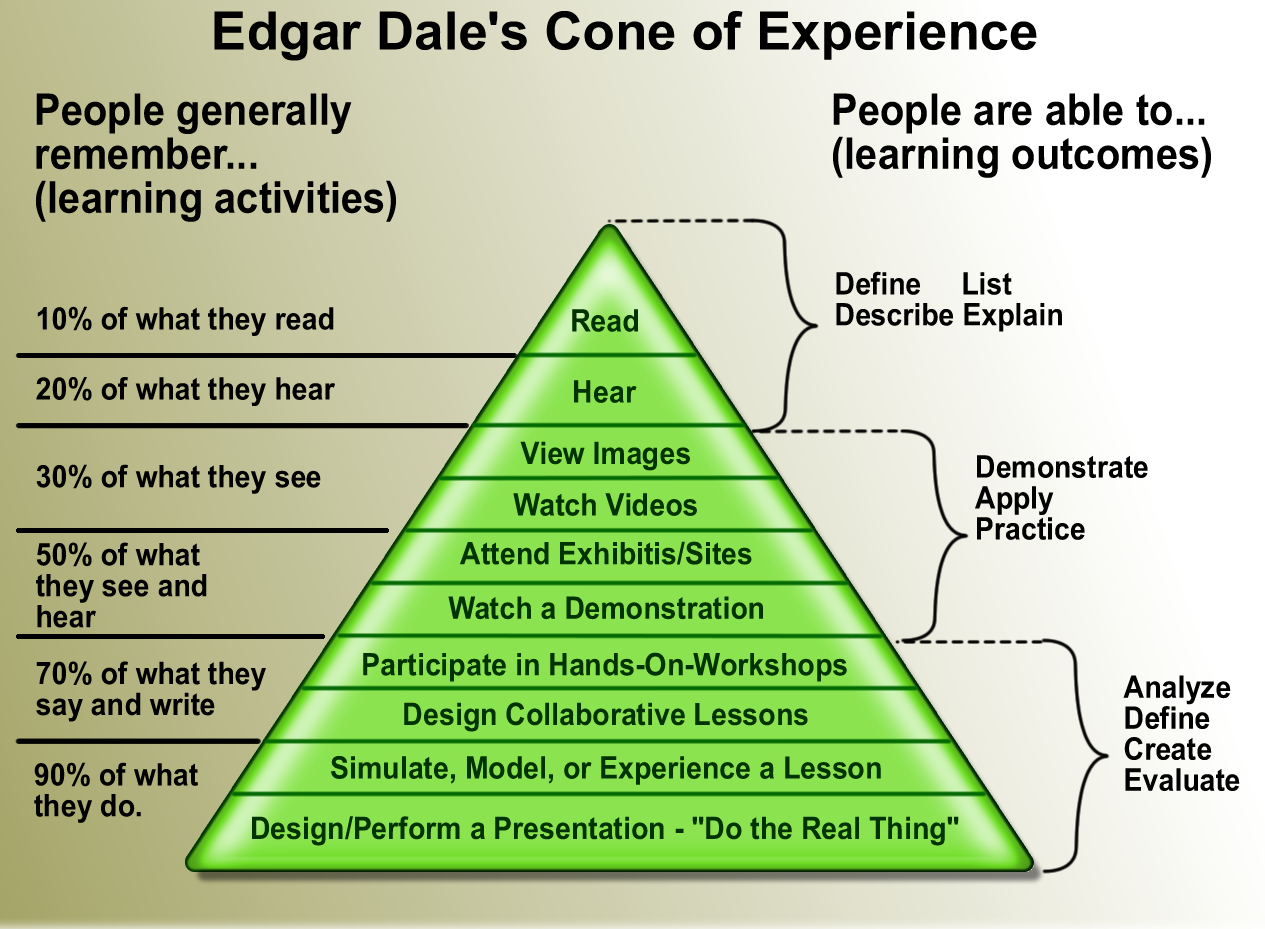
Cone of Learning Edgar Dale
A well-rendered graphic of the theories presented by Edgar Dale regarding human learning from https://upload.wikimedia.org/wikipedia/en/2/29/Cone_of_learning_export_11x17.png

Feedback

I also received some important feedback on incorporating more active learning strategies and some ideas about which types of activities the students preferred.  The feedback was solicited at the beginning of the discussion. As the students read the article and responded there seemed to be increasing evidence that their ideas and preferences were aligned with the findings of the researchers. I wonder if we asked students for feedback regularly if we could adjust our teaching styles and methodologies to better meet the need for active learning.

Boredom is the Enemy
created by rcarnill90 for this post in Canva

What We Already Knew

At the end of the article I asked the students to view the video below as it related to active learning theory. When we discussed the video we found we already knew a lot about the topic. Now what was left was to begin applying our knowledge to make it our practice, as I plan to do in the future class meetings for EDU585.


Monday, January 28, 2019

HyperDocs: Docs Beyond Word Processing

Beyond Word Processing

Where We Are

I always start this Educational Technology Applications course, EDU585, with a survey of student skills, a needs assessment if you will. I like to get a handle on the kind of learner I am dealing with by getting a snapshot or pulse on their skills, abilities, knowledge and dispositions. I start by asking each learner to share a few insights about how they see themselves as a user of technology.

This group, along with many others, have rated themselves highly in word processing. There is a great deal to know about the word processing tool and the associated techniques. I wonder how they as teachers will employ this tool and what capabilities they feel it possesses as an instructional game changer. I hope that they reach beyond reports, headers, footers, citations and the like.

HyperDocs According to the Experts

I know at this point in the program they have had their fair share of research papers and response papers and term papers to write. They must have found success in using word processing to document their learning. So, I want to make sure that they are prepared to use this tool in their teaching. Enter, the Hyperdoc...word processing beyond word processing. If you are not sure what exactly is a Hyperdoc, then you need to visit the HyperDoc Girls website to learn more.

Once you understand the basic concept of transforming student learning through the use of personalized digital lessons and instructional delivery. You should dig a little deeper by listening to this Google Teacher Tribe interview with practitioner Sean Fahey. (There is A LOT of INFO in this session...the interview with Sean starts around the 14:30 mark).


Matt Miller and Kasey Bell continue the conversation about Hyperdocs by going back to the source. They interview one of the original HyperDoc Girls, Lisa Highfill in the very next episode of the Google Teacher Tribe podcast. (Once again...tons of info...the chat with Lisa starts at about 5:30 mark).


Transforming Teaching and Learning

And now I want to point you back to Sean Fahey and a blog post featured on Matt Miller's Ditch That Textbook site. Sean cover's 9 Reason's Why HyperDocs Can Transform Your Class. While you are reading this, consider the ISTE Standards for Educators and jot a little note about each one as your read the blog. Do you remember all 7??? Well then, you can refer back to them at https://www.iste.org/standards/for-educators. How might this information change your ideas about word processing, delivery of instruction and evidence of learning?